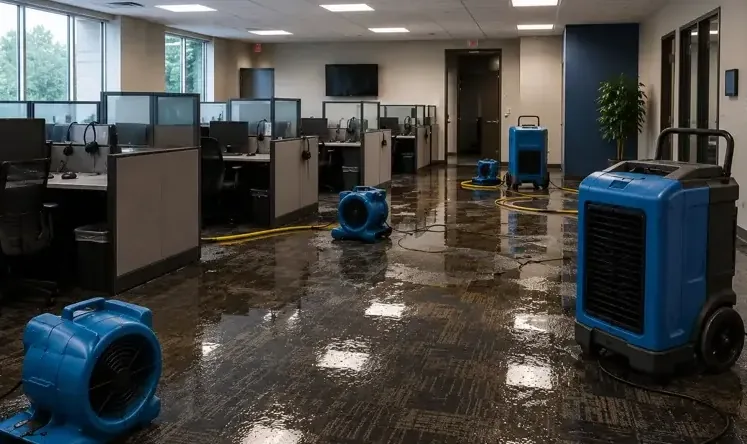
A burst pipe, a failed roof drain or a flooded floor can close a business for longer than the water itself matters. Midvale mixes a historic downtown along 700 West and Main Street, Bingham Junction as the economic center of the west side, and the Shops at Fort Union on the eastern edge.
Key takeaways
- Different parts of the city have different kinds of buildings, so the plan starts with reading the building, not the address.
- The first moves are stopping the source, making the space safe, protecting stock and records and photographing everything.
- Phased drying works in zones so part of a business can stay open while another part dries.
- Tenants, landlords and neighbors share walls and floors, so a loss in one suite can reach others.
- Drying is finished when the readings match a dry reference, not when the space looks dry.
Three kinds of business property
Midvale became a city in 1909, and its commercial areas grew in different places for different reasons. Reading the building comes before choosing the equipment.
A business that rents space may not control the pipes above or beside it, so the first contact is often the property manager as well as the restoration team.
Downtown along Main Street
Historic downtown runs along 700 West and Main Street. Small shops, offices and service businesses often sit side by side, and a leak in one can wet the shared wall of the next.
Bingham Junction and the west side
Bingham Junction is the economic center on the west side, and the west side of the city became industrial. Larger floor plates, warehouse space and mixed office areas call for a plan that covers big open floors and storage as well as offices.
The Shops at Fort Union area
Fort Union, an early settlement on the eastern edge, brought the Shops at Fort Union when it was annexed. Retail space there is built around customer traffic, so protecting floors and keeping aisles safe comes first.
The first moves after a loss
The first hours decide how much of the loss is water and how much is lost business. The order matters more than speed for its own sake.
Power is the hazard that is easiest to overlook in a commercial space. Floors, display cases and equipment can carry current when water is near outlets and panels, so staff should stay out until the area is cleared.
- Stop the water at its source: close the valve, shut off the supply or isolate the roof drain.
- Cut power to wet areas from a dry location, and keep staff and customers out of them.
- Photograph the damage before anything is moved.
- Move stock, files and equipment out of the water and onto dry surfaces.
- Tell the landlord, the property manager and the insurer.
Stock, records and equipment
A business has more to lose than the building. Inventory, records and electronics all need a plan.
Porous stock such as cardboard, fabric and paper takes up water and may not be savable. Hard goods can often be wiped, dried and returned to shelves.
Refrigeration, point of sale systems and server closets are the items that stop a business first. Move or protect them before the rest.
- Lift inventory off wet floors first, then sort what is wet from what is dry.
- Keep an itemized list with photos for the insurer.
- Move computers, servers and files out of the affected area before they are touched by water.
- Ask before throwing anything away that the insurer may want to see.
Phased drying so the doors can stay open
A commercial water damage job rarely needs the whole space closed. The team divides the area into zones, contains the wet one and keeps the rest running.
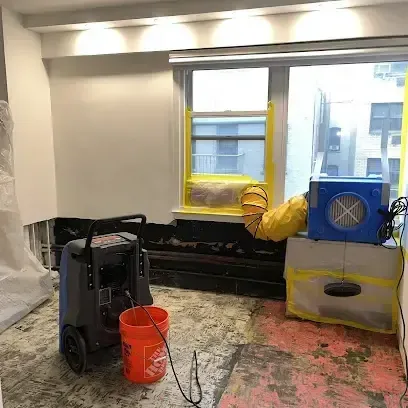
Drying equipment is placed by zone, and the readings tell the team when a zone is ready to reopen. Customers and staff can use the dry part while the wet part works.
Where the building allows, noisy work can be scheduled around opening hours, and walkways can be kept clear and marked so customers never cross a wet floor.
- Zone the space by how wet each area is.
- Contain the wet zone with barriers so air and dust stay inside it.
- Place air movers and dehumidifiers by zone and log the readings daily.
- Reopen zones one at a time as the readings come back dry.
Tenants, landlords and shared walls
A water loss in one suite does not respect a lease boundary. Shared walls, floors and ceilings can carry water to neighbors, upstairs and downstairs.
Tenants and landlords should agree early on who is in charge of the response, who calls the insurer and how neighbors will be told. A short written note avoids disputes later.
- Who closes the water supply to the affected suite?
- Who owns the damaged ceiling, walls and floor finish?
- Who tells the neighboring tenants and the building manager?
- Who keeps the photos, readings and invoices in one place?
How dry is dry
The target for structural drying is a reading, not a look. Framing, subfloor, drywall and concrete are dried to within 2 to 4 points of a dry reference.
The drying time estimator gives a rough idea of how long drying may take. The real schedule comes from the readings on the job.
Closing up early is the most common reason a wall is opened a second time. A ceiling tile or baseboard put back over damp framing can hold moisture for weeks.
Records for the insurer and landlord
A commercial claim often involves the building owner's insurer and the tenant's insurer. Both want a clear record.
- Dated photos of the damage, before and after cleanup.
- Moisture readings from the first day to the last.
- A list of materials removed and why.
- Invoices and a note of the dates the space was closed or partly closed.
Questions
Can a business stay open during drying?
Often part of it can. Phased drying splits the space into zones, so the dry zones stay in use while the wet zone is contained and dried.
What happens to stock that got wet?
Porous stock such as cardboard, fabric and paper often cannot be saved. Hard goods can often be dried and returned, and an itemized list with photos supports the insurance claim.
Who calls the insurer, the tenant or the landlord?
Both may need to. The building owner's insurer usually covers the structure and the tenant's insurer the contents and business loss, so each should be told early.
How is drying measured?
With moisture readings on framing, subfloor, drywall and concrete. The goal is within 2 to 4 points of a dry reference.
Does the type of building change the plan?
Yes. A small shop, a warehouse floor and a retail space each hold water differently, so the team reads the building before choosing equipment.
How is a commercial loss different from a home loss?
A business has stock, records, equipment and customers on top of the structure. The plan protects those and keeps open zones safe, which is why phased drying matters.